
US Central Command (CENTCOM) forces conducted additional strikes against multiple targets in Iran, on Saturday (local time), at the commander in chief, US President Donald Trump's direction.

A comprehensive schedule detailing the events and timings for Indian athletes participating in the Asian Games on Tuesday, September 29, across various sports including archery, athletics, boxing, shooting, tennis, and more, with numerous medal events highlighted.

As Tehran and Washington continue with their engagements following the signing of the MoU earlier this month, sources have told Al Arabiya that the two are set to hold the next round of negotiations in Switzerland on June 28 and 29.

India continued its strong performance at the Asian Games, securing gold medals in both men's and women's Kabaddi, a historic silver in marathon by Sawan Barwal, and advancing to squash finals. The day also saw mixed results in shooting, athletics, and badminton, contributing to India's growing medal tally.
China has established a significant lead in the Aich-Nagoya Asian Games medal tally after the third official day, securing 53 medals including 32 golds. Japan and Korea follow in second and third place respectively, while India is currently positioned eighth with 7 medals.

Indian shooters Kamaljeet and Suruchi Singh secured a gold medal in the 10m air pistol mixed team event at the Asian Games in Nagoya, bouncing back from individual disappointments. They dominated the final, finishing significantly ahead of South Korea.

Indian stock market benchmark indices Sensex and Nifty recorded their second consecutive day of decline, with the Sensex dropping 555.23 points and the Nifty falling 144.05 points, primarily due to rising crude oil prices and ongoing US-Iran hostilities in West Asia.

Ebrahim Azizi, Head of the Iranian Parliament's National Security Committee, warned the US against interfering with the Strait of Hormuz, asserting Iran's sovereignty after former President Donald Trump threatened to 'take over' the strategic waterway. Despite the heated rhetoric, Iran and the US have established a direct communication line to prevent incidents during a 60-day negotiation period.

Iranian Foreign Minister Seyed Abbas Araghchi announced the official end of the war and warned that any Israeli attack on Lebanon would violate an agreement between Iran and the United States. He also stated that negotiations on nuclear issues and sanctions lifting would begin on Saturday, led by Iran's Parliamentary Speaker M B Ghalibaf and US Vice President J D Vance.

After a significant 9.9% depreciation in FY26, the Indian rupee has shown comparative stability in the first half of FY27, depreciating by only 1.1%, attributed to regulatory interventions and measures to attract foreign capital, despite ongoing global pressures from rising crude oil prices and foreign investor outflows.

Shailesh Chandra, MD and CEO of Tata Motors Passenger Vehicles (TMPV), stated that the uncertainty surrounding how long commodity costs will remain elevated is a greater concern for the company than the actual price increases. He noted that commodity prices have risen significantly over the past five to six months, impacting margins and necessitating faster cost-reduction efforts, though no major production or supply-side issues are currently foreseen.

The highlight of the successful BRICS Summit was its ability to deliver a joint statement that all members, including Iran and the United Arab Emirates, embroiled in the war in West Asia, signed.

US President Donald Trump claimed on Tuesday that Tehran has consented to long-term, comprehensive monitoring of its nuclear infrastructure. Concurrently, Washington will ease shipping constraints in the Strait of Hormuz and release bound financial concessions, subject to stringent American oversight.

The advisory follows recent developments, including Israeli airstrikes targeting central and western Iran.

India on Tuesday reiterated the call for free and safe navigation in international waters and the unhindered flow of commerce through international waterways in the region after the Panama-flagged commercial vessel MT El Gaia came under attack off the coast of Oman, with 13 of the 14 Indian nationals on board rescued while search operations are underway for one missing seafarer.

Indian shooters Suruchi Singh and Kamaljeet secured a gold medal in the 10m air pistol mixed team event at the Asian Games, demonstrating a strong comeback after individual disappointments. Additionally, the men's 50m rifle 3 positions team, comprising Aishwary Pratap Singh Tomar, Rudrankksh Patil, and Niraj Kumar, earned a silver medal, with Tomar and Niraj also qualifying for individual finals.

The Iranian football team is facing significant travel restrictions in the US during the World Cup, requiring them to enter and leave within 24 hours of matches. This has led the Football Federation of Iran to lodge a formal complaint with FIFA, citing concerns over fair play and technical preparation, while US authorities maintain the measures are for safety and security.
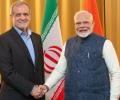
Prime Minister Narendra Modi has welcomed the understanding between the United States and Iran to end the conflict in West Asia, expressing hope that the pact will restore peace, stability, and ensure freedom of navigation in the region. The deal, aimed at ending a 107-day war that caused a global energy crisis, is set for signing on June 19.

The United States and Iran have reached an agreement in principle to immediately and permanently halt all military operations, lift sanctions, and work towards a comprehensive final agreement within 60 days, including a significant reconstruction package for Iran.

Foreign portfolio investors (FPIs) have withdrawn nearly Rs 5,109.21 crore from Indian government securities under the fully accessible route (FAR) in just three days, driven by global uncertainty, elevated crude prices, rising US Treasury yields, and a depreciating rupee.

The Indian women's recurve archery team secured a historic gold medal at the Asian Games by defeating 10-time Olympic champions South Korea. The team, comprising Ankita Bhakat, Kirti Sharma, and Kumkum Mohod, displayed exceptional nerve in challenging conditions.

India's Manush Shah and Diya Chitale secured a historic medal in mixed doubles table tennis at the Asian Games by defeating Hong Kong's world No. 4 pair. This marks India's second mixed doubles medal in Asian Games history. While other Indian paddlers faced early exits in various categories, Shah also advanced in men's singles and Yashaswini Ghorpade in women's singles.

Iran coach Amir Ghalenoei said travel restrictions and visa-related disruptions hampered his team's World Cup preparations after a 2-2 draw with New Zealand, claiming Iran had become the tournament's "most oppressed" side.

United States President Donald Trump has threatened to resume 'very hard' attacks on Iran, expressing frustration over Tehran's delays in signing a negotiated deal and citing the downing of a US Apache helicopter as grounds for renewed military action. Russia has called for restraint and a return to diplomacy amidst escalating tensions.

The Indian stock market's movement this week will be significantly influenced by the outcome of US-Iran talks, global crude oil prices, and the trading activities of foreign institutional investors (FIIs), according to market analysts.

Iranian President Masoud Pezeshkian is on a state visit to Pakistan to discuss the full implementation of an agreement signed between Iran and the US, alongside regional and international developments. The visit also aims to strengthen bilateral cooperation across various sectors, following recent high-level talks between the US and Iran in Switzerland regarding regional security.

Iran has restored access to a significant portion of its underground missile infrastructure following months of excavation and repair work, highlighting the limits of US bombing strategy.

'Work hard and have patience, because after long, hard work you achieve your target. Always stay disciplined, work hard and be passionate about your sport.'

Iran's Deputy Foreign Minister Kazem Gharibabadi confirmed a peace deal with the United States, stating that Tehran will enter a 60-day negotiation period only after verifying Washington's commitments to ending hostilities, lifting the blockade, and releasing Iranian assets.

Indian athletes are set for a busy day at the Asian Games on October 2, with events across archery, boxing, canoe slalom, cycling, golf, hockey, rugby sevens, sailing, sepak takraw, taekwondo, volleyball, and wrestling. Key medal events include finals in boxing featuring Lovlina Borgohain and Parveen Hooda, and the women's hockey final against China.

United States President Donald Trump and Iranian President Masoud Pezeshkian have virtually signed a 14-point memorandum of understanding (MoU) to end hostilities, reopen the Strait of Hormuz, and begin a 60-day negotiation process on sanctions and Iran's nuclear programme.
Following the signing of a 14-point Memorandum of Understanding (MoU) with Iran, US President Donald Trump reiterated the terms for a 60-day negotiation period, vowing that Tehran will receive "not ten cents" in financial relief.

Iran footballers faces cheers and jeers in their come-from-behind 2-2 draw against New Zealand in their FIFA World Cup final opener in Los Angeles on Monday.

Andrew Giuliani, executive director of the White House Task Force for the World Cup, confirmed that the US will continue to assess Iran's travel arrangements for the tournament despite their complaints about restrictions.

Indian benchmark indices Sensex and Nifty opened higher, extending gains from the previous session, driven by a rally in global markets and a slight cooling in crude oil prices. Optimism around a potential meeting between US and Iranian presidents also contributed to positive sentiment.Later both indices pared gains and were trading in red. Track Sensex, Nifty on September 22.

US President Donald Trump has cautioned Israeli Prime Minister Benjamin Netanyahu that Israel risks international isolation if it resumes extensive military operations against Iran, following a volatile 24-hour period of escalating cross-border hostilities.

US President Donald Trump announced a finalised peace deal between the US and Iran, set for signing on June 19 in Switzerland, with key figures like J D Vance, Steve Witkoff, and Jared Kushner from the US side, and Abbas Araghchi and Mohammad Bagher Ghalibaf representing Iran, alongside Pakistani mediators Field Marshal Asim Munir, Shehbaz Sharif, Ishaq Dar, and Mohsin Naqvi, playing crucial roles in the diplomatic breakthrough.

Donald Trump claims a peace deal with Iran is 'largely negotiated' after calls with Israel and other allies, but Iran rejects Trump's claim on Strait of Hormuz.

India is hosting the 18th BRICS Summit in New Delhi, bringing together numerous world leaders including presidents from China, Russia, South Africa, Iran, and Egypt, along with prime ministers and foreign ministers from other nations. The summit will feature bilateral talks and highlights the expanded BRICS grouping's growing global influence and India's significant role as a founding member and current chair.

India's Manush Shah and Diya Chitale secured a bronze medal in the mixed doubles table tennis event at the Asian Games after a 0-4 loss to China in the semifinals. This marks India's first table tennis medal at the current Games and only the second mixed doubles medal in Asian Games history, following Sharath Kamal and Manika Batra's bronze in Jakarta.
